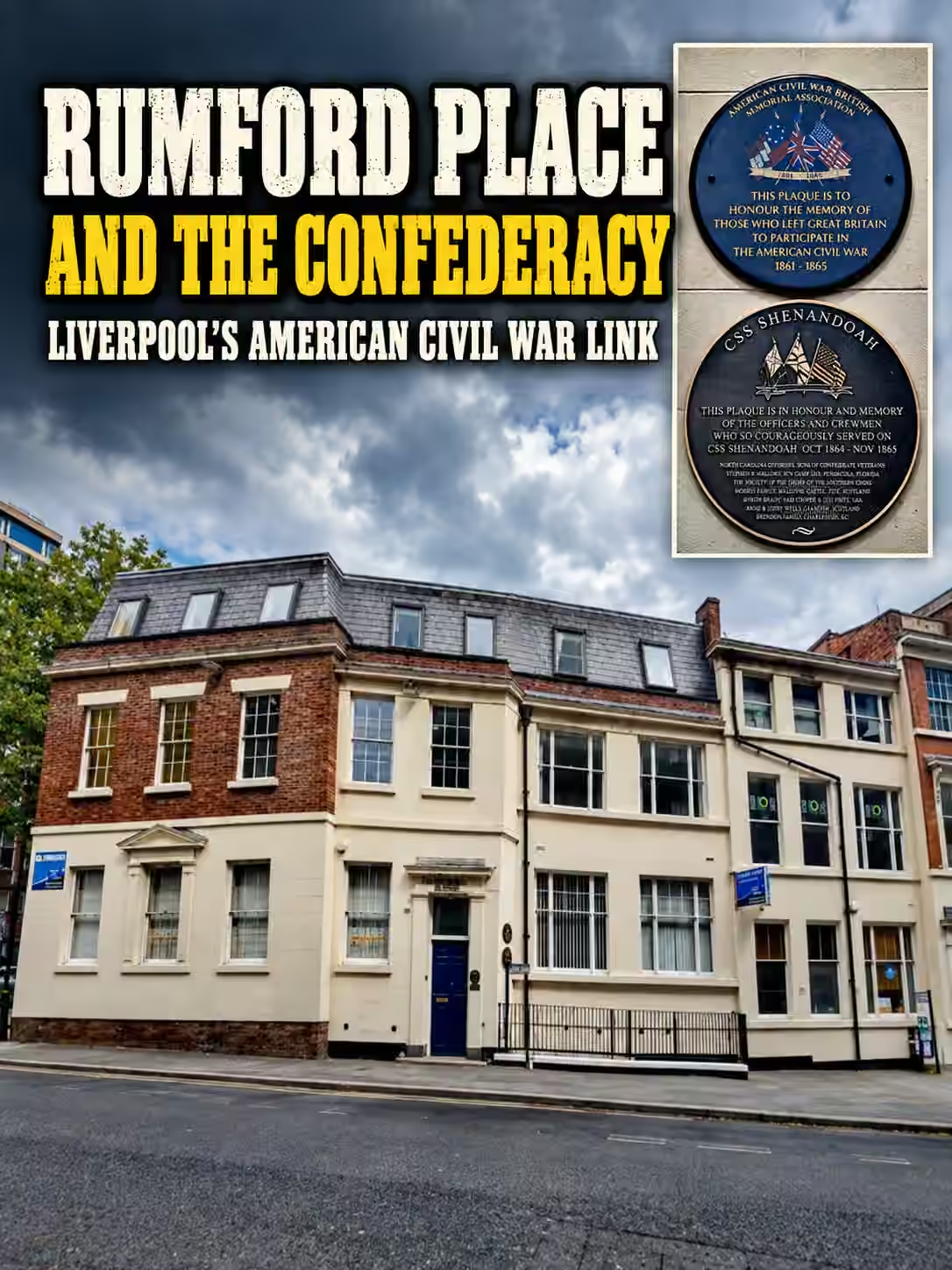
Walk along Rumford Place today and there is little to suggest that this quiet Liverpool street once stood at the centre of an international conflict.
Yet during the American Civil War, offices here became a headquarters for Confederate activity in Britain.
At 10 Rumford Place, the Liverpool merchant house Fraser, Trenholm & Co. handled Confederate money and purchasing arrangements. Confederate naval agent James Dunwoody Bulloch also worked from the building while arranging ships for the Southern war effort.
Its role was significant enough for Historic England to describe the building as being “in effect the Confederate Embassy in England.” [1]
Across the Mersey, one of the most famous Confederate warships would be built. Elsewhere in Liverpool, American agents were watching Bulloch and attempting to stop him. Officially, meanwhile, Britain was neutral.
FRASER, TRENHOLM & CO. — THE RUMFORD PLACE CONNECTION
Fraser, Trenholm & Co. was not simply another Liverpool cotton merchant. The Liverpool business was connected with John Fraser & Co. of Charleston, South Carolina, whose leading figure was George Alfred Trenholm. The Liverpool operation was managed by Charles Kuhn Prioleau, a South Carolinian who became a naturalised British citizen.
When the American Civil War began in 1861, this commercial network became extremely useful to the newly formed Confederate government.
The United States case later presented to the international arbitration tribunal recorded Fraser, Trenholm & Co. as Confederate financial agents and depositories in Britain. Confederate purchasing agents could draw against money and cotton placed with the Liverpool firm, allowing supplies bought in Europe to be paid for through the Rumford Place operation. [2]
In simple terms, cotton leaving the Confederacy could help generate credit in Liverpool. That credit could then be used to buy weapons, equipment and other supplies needed by the Confederate government.
In 1864 George A. Trenholm became Confederate Secretary of the Treasury. [2]
WHY LIVERPOOL MATTERED
Liverpool’s importance to this story begins with cotton. By the middle of the nineteenth century, Liverpool was one of the world’s great cotton ports. National Museums Liverpool records that by 1850 cotton accounted for around half of the city’s trade. [3]
Much of the American cotton arriving through Liverpool came from the Southern states and had been produced by enslaved labour.
When war began in April 1861, the Union attempted to blockade Confederate ports. The South needed to export cotton to obtain money and credit while importing weapons, machinery and manufactured goods.
Liverpool already possessed almost everything required to help make that possible: merchants, banks, shipowners, engineers, warehouses, maritime suppliers and some of the world’s leading shipyards.

JAMES DUNWOODY BULLOCH
James Dunwoody Bulloch reached Liverpool on 3 June 1861. A former United States naval officer, he had joined the Confederate cause and had been ordered to obtain vessels overseas.
The United States already possessed an established navy. The Confederacy did not. Bulloch’s mission was therefore to use European shipyards and suppliers to create part of a Confederate naval force abroad.
With Fraser, Trenholm & Co.’s backing, Bulloch contracted for vessels that would ultimately become CSS Florida and CSS Alabama. Historic England identifies the Rumford Place building as Bulloch’s headquarters while he commissioned Confederate cruisers in Britain, particularly on Merseyside. [1][4]
A SECRET WAR IN LIVERPOOL
Bulloch was not operating unnoticed. The United States consul in Liverpool, Thomas Haines Dudley, was trying to stop him.
Dudley developed an intelligence network around Liverpool’s shipyards and docks. Informants were recruited, ship movements watched, documents obtained and evidence collected. Information from Liverpool was passed to Charles Francis Adams, the United States minister in London, who pressed the British government to intervene. [4]
From Rumford Place, Confederate agents were trying to acquire ships. Elsewhere in Liverpool, American representatives and their informants were trying to identify those ships before they could escape.
One of their greatest battles centred on a vessel known simply by a number: 290.
NO. 290 — THE SHIP THAT BECAME CSS ALABAMA
No. 290 was being constructed across the Mersey by Laird Brothers at Birkenhead. American officials suspected that although she appeared to be an ordinary commercial vessel, her intended destination was Confederate service.
Dudley worked with lawyers and British officials to turn intelligence into formal evidence, including sworn depositions. [4]
By 29 July 1862, the Crown’s law officers concluded that sufficient grounds existed for the vessel to be detained. There was one problem: they were a day too late.
No. 290 — temporarily sailing as Enrica — had left the Mersey on 28 July. She later rendezvoused with supply vessels in the Azores, where she was armed and commissioned as CSS Alabama. [4]

THE RUMFORD PLACE NETWORK GOES GLOBAL
Alabama hunted United States merchant shipping. Confederate commerce raiders aimed to damage Northern trade and force the United States Navy to divert resources into hunting them.
Alabama captured or destroyed dozens of United States merchant ships before being sunk by USS Kearsarge off Cherbourg in June 1864. [5]
Behind that global voyage lay a chain leading back to Merseyside: a Confederate naval agent working in Liverpool, financial assistance connected with Fraser, Trenholm & Co., and a vessel constructed in Birkenhead.
BUT BRITAIN WAS OFFICIALLY NEUTRAL
This is where the story needs an important distinction. Liverpool as a city did not officially support or supply the Confederacy. Nor was the British government a Confederate ally.
On 13 May 1861, Queen Victoria issued a proclamation declaring Britain’s intention to maintain “strict and impartial neutrality” between the two sides. British subjects were warned against fitting out or equipping warships for either belligerent. [6]
Britain recognised the Confederacy as a belligerent for the purposes of international law, but it never formally recognised the Confederate States as an independent country.
That distinction created the legal battlefield on which Bulloch and Dudley operated.
LIVERPOOL WAS DIVIDED
The story should not be reduced to the idea that Liverpool simply “supported the Confederacy”.
Commercial connections with Southern cotton created substantial Confederate sympathies among some merchants and businessmen. Others supported the Union or opposed slavery.
Liverpool therefore contained competing interests: Confederate agents, Union agents, merchants making their own commercial decisions, and a British government attempting — not always successfully — to enforce neutrality.
THE ALABAMA CLAIMS
The consequences of what happened on the Mersey lasted long after the Civil War ended.
The United States argued that Britain had failed in its neutral responsibilities by allowing vessels such as Alabama to escape and subsequently attack American shipping.
After years of diplomatic argument, Britain and the United States signed the Treaty of Washington in 1871, creating an international arbitration process.
The tribunal delivered its decision in 1872, awarding the United States $15.5 million in damages. [5]

THE CONFEDERACY RETURNS TO THE MERSEY
Four years after Bulloch arrived in Liverpool to begin acquiring ships for the Confederacy, another Confederate warship entered the Mersey.
This time it had not come to begin its war. It had come to end it.
CSS Shenandoah had spent months attacking United States merchant and whaling vessels around the world. Because news travelled slowly, her crew continued operations after the principal Confederate armies had surrendered.
After receiving reliable confirmation that the Confederacy had collapsed, commander James Iredell Waddell headed for Britain.
On 6 November 1865, Shenandoah came up the Mersey and surrendered to British authorities, represented by HMS Donegal. The U.S. National Archives describes the Liverpool surrender as the final Confederate surrender of the American Civil War. [7]
Liverpool had been deeply involved in the Confederacy’s overseas naval story near its beginning. Remarkably, it was there at the end as well.
WHAT SURVIVES TODAY
The buildings associated with this extraordinary story still stand in Rumford Place.
Historic England’s Grade II listing for Nautilus House, incorporating 6, 8 and 10 Rumford Place, specifically records the site’s connection with James Dunwoody Bulloch and Confederate shipbuilding.
Its official listing concludes: “This building was in effect the Confederate Embassy in England.” [1]
That does not mean Britain recognised an official Confederate embassy here. It did not. But it conveys just how important Historic England considers the activities conducted from this Liverpool address.
Today it is an easy building to walk past without a second glance. Yet from offices in Rumford Place, Confederate finances were handled and naval operations supported while American agents watched from elsewhere in Liverpool.
Across the Mersey, the Alabama was built and escaped to sea. Four years later, Shenandoah returned to the same river to make the final Confederate surrender.
Few Liverpool streets have a more extraordinary connection with the American Civil War.
Citations
SOURCES & FURTHER READING
- Historic England — Nautilus House, 6, 8 and 10 Rumford Place. National Heritage List entry 1292483. Records Bulloch’s headquarters and the building’s Confederate significance. Historic England.
- U.S. Department of State, Office of the Historian. Historical records concerning Fraser, Trenholm & Co., Confederate cotton and finance. Office of the Historian.
- National Museums Liverpool. Background on Liverpool’s cotton economy and its connections with slavery and Atlantic commerce. National Museums Liverpool.
- U.S. National Archives — The Diplomats Who Sank a Fleet. Bulloch, Dudley, No. 290, Confederate shipbuilding and the Union consular intelligence operation. U.S. National Archives.
- U.S. Department of State — The Alabama Claims, 1862–1872. Office of the Historian.
- Queen Victoria’s Proclamation of Neutrality, 13 May 1861. Reproduced in U.S. diplomatic records. Office of the Historian.
- U.S. National Archives and U.S. Naval History and Heritage Command — CSS Shenandoah. Records the surrender at Liverpool on 6 November 1865. Naval History and Heritage Command.
Continue the conversation
Share this Liverpool story
Follow Out in Liverpool or bring your own memories and knowledge to the Community Group.