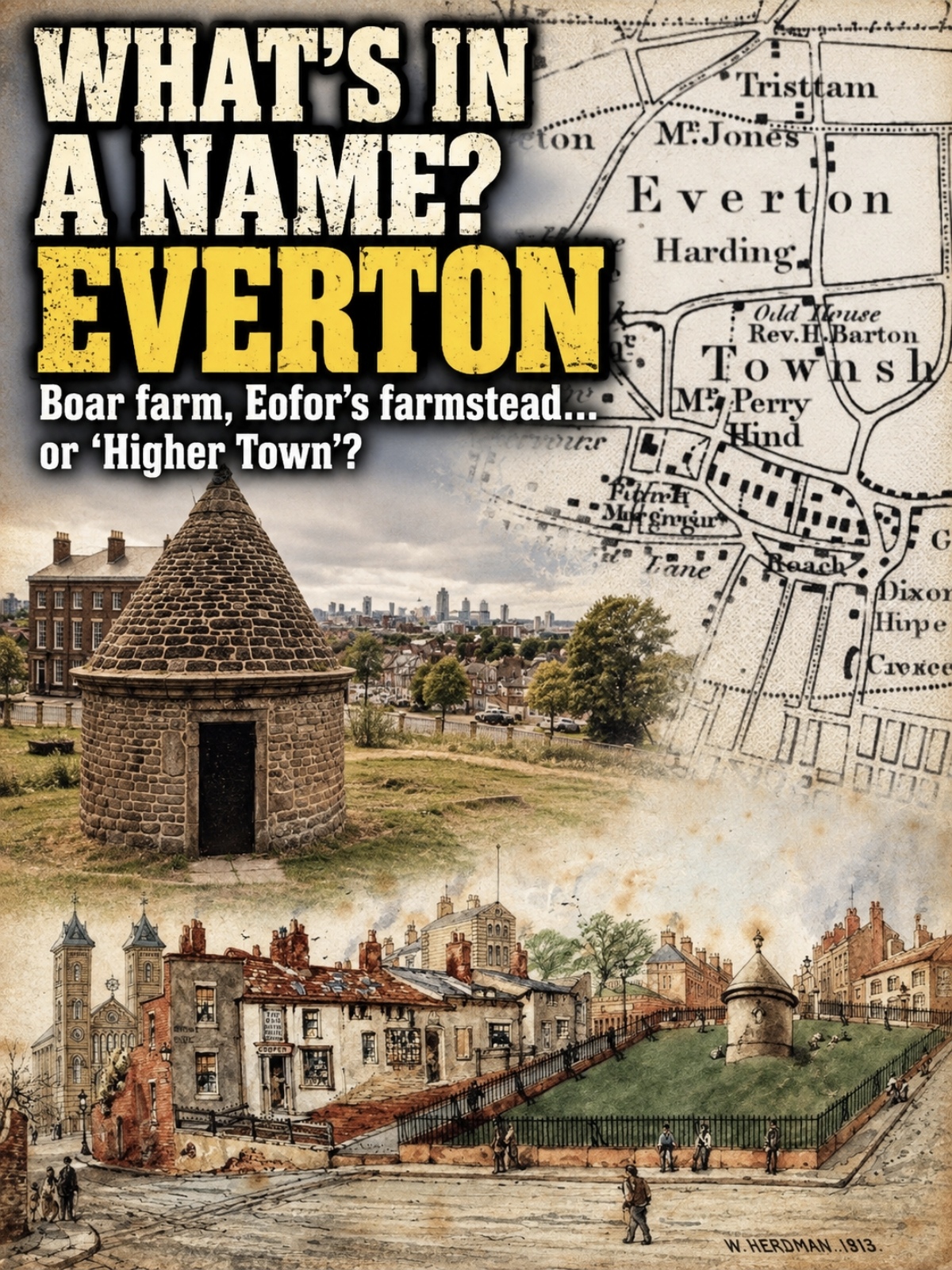
Today, Everton is a name recognised around the world. Football helped carry it there. But the club borrowed its name from a place that was already ancient — a settlement on high ground overlooking Liverpool whose origins reach back many centuries before the city became a great port.
The strongest linguistic evidence points towards an Anglo-Saxon origin involving a wild boar — or perhaps a man whose name meant one. But an older interpretation offers something altogether different: “Higher Town.” Stand on Everton Brow and it sounds almost too perfect. The trouble is that place-name evidence does not always follow the landscape.
AN ANGLO-SAXON NAME
The generally accepted starting point is Old English: eofor + tūn.
Tūn originally referred to an enclosure, farmstead or settlement. It appears throughout English place names and eventually developed into the modern word town.
The first element is more interesting. Eofor meant wild boar. Taken literally, Everton could indicate an enclosure or settlement associated with boars.
But Eofor — also encountered in forms such as Efer — was also an Anglo-Saxon personal name. That opens another interpretation: Eofor’s farmstead.
Liverpool place-name researcher Henry Harrison favoured this explanation in his 1898 study The Place Names of the Liverpool District. Modern Liverpool historic-settlement research allows for both possibilities: the animal element eofor and the personal name Eofor. We should therefore resist turning either into a certainty the evidence does not provide.
JUST HOW OLD IS EVERTON?
The documentary story is less tidy. The Liverpool Historic Settlement Study gives the early form Evretona and dates it to 1094. That would put a recognisable ancestor of the name only eight years after the completion of Domesday Book.
But Harrison, writing in 1898, said the earliest Everton reference he had identified was a document of 1225, where the place was already written Everton.
Rather than quietly combining the dates into a neat sequence, the difference should be acknowledged: modern historic-settlement research cites Evretona in 1094; Harrison regarded the 1225 document as the earliest Everton reference he had found.
Either way, by the medieval period the name was firmly established.
WHERE IS EVERTON IN THE DOMESDAY BOOK?
Domesday Book was completed in 1086, yet Everton does not straightforwardly appear under the name we recognise. That absence puzzled local historians and produced one of the most persistent alternative explanations for the name.
The argument centred on a place recorded by Domesday as Hiretun.
In his 1830 history of Everton, Liverpool antiquarian Robert Syers identified Domesday’s Hiretun with Everton. His interpretation was wonderfully attractive: Everton stood high above neighbouring settlements, so the name could essentially represent the higher town.
STAND ON EVERTON BROW AND THE THEORY MAKES SENSE
The historic village occupied elevated ground around Everton Brow and Village Street. From the ridge, the land falls dramatically towards Liverpool. Before nineteenth-century urban expansion swallowed the surrounding countryside, that distinction would have been even more obvious.
An old local pronunciation resembling “Yerton” added another ingredient. So the interpretation became Higher Town, or in some versions something approaching “Over Town”.
Unlike many pieces of local folklore, this has a genuine historical pedigree. Syers was attempting to reconcile medieval documentary evidence with the landscape he knew.
HARRISON VERSUS SYERS
Henry Harrison returned to the Hiretun question in 1898 and explicitly disagreed with Syers. Harrison examined the context in which Hiretun appeared in Domesday and concluded that it could not convincingly be identified with Everton.
Following an alternative identification made by historian William Beaumont, Harrison considered Tarleton the more probable location of Hiretun. He suggested Everton was probably among settlements belonging to the large manor of West Derby that Domesday did not individually identify by name.
So “Everton means Higher Town” is not simply a myth. It is a genuine historical theory. But it depends upon identifying Everton with Domesday’s Hiretun — an identification subsequently challenged on documentary grounds. The linguistic evidence for eofor + tūn is stronger.
EVERTON BEFORE LIVERPOOL SWALLOWED IT
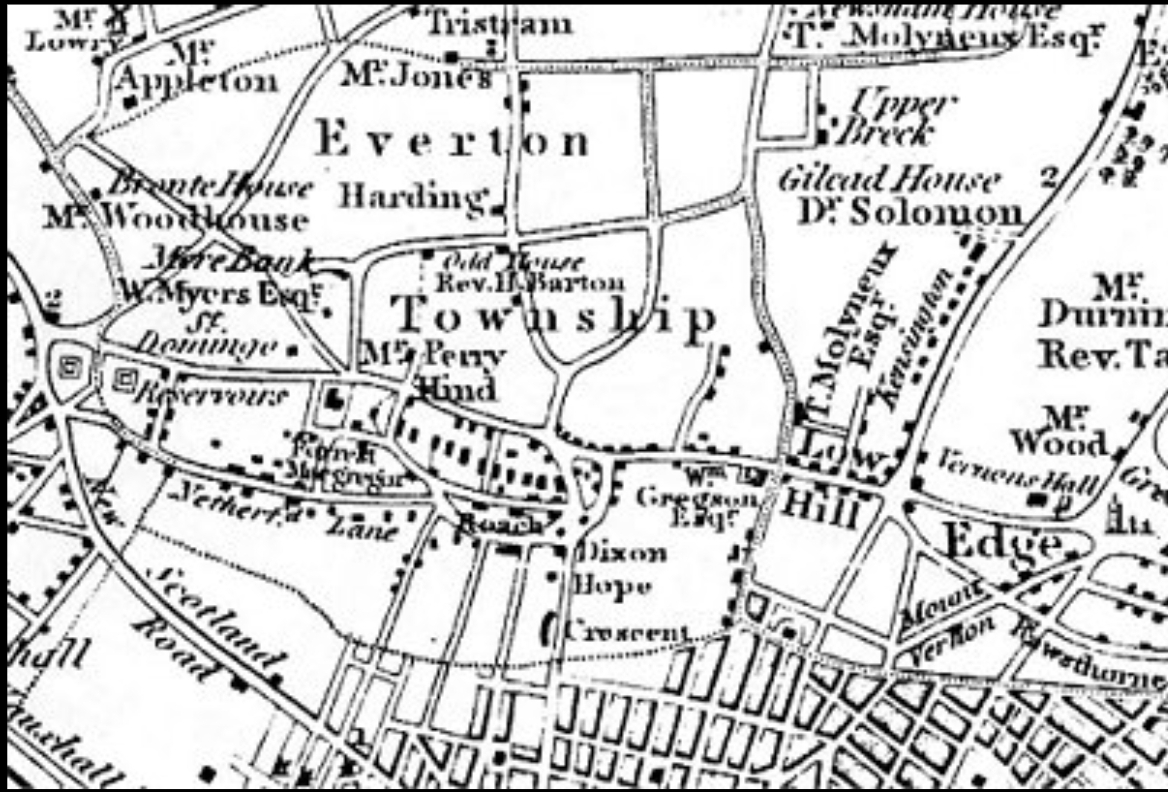
The 1823 map of Everton Township gives us a glimpse of the landscape that made the Higher Town theory so seductive. Liverpool was expanding rapidly northwards, but Everton had not yet disappeared completely into the continuous urban city that developed during the nineteenth century.
Fields remained, roads followed older routes and the settlement retained a distinct identity on its elevated ground.
THE LITTLE PRISON ON THE BROW
Standing on Everton Brow is one of the district’s most distinctive landmarks. The Everton Lock-Up dates from 1787. Built from red sandstone, circular in form and topped by its unmistakable conical roof, it provided temporary confinement for people detained locally. Today it is Grade II listed.
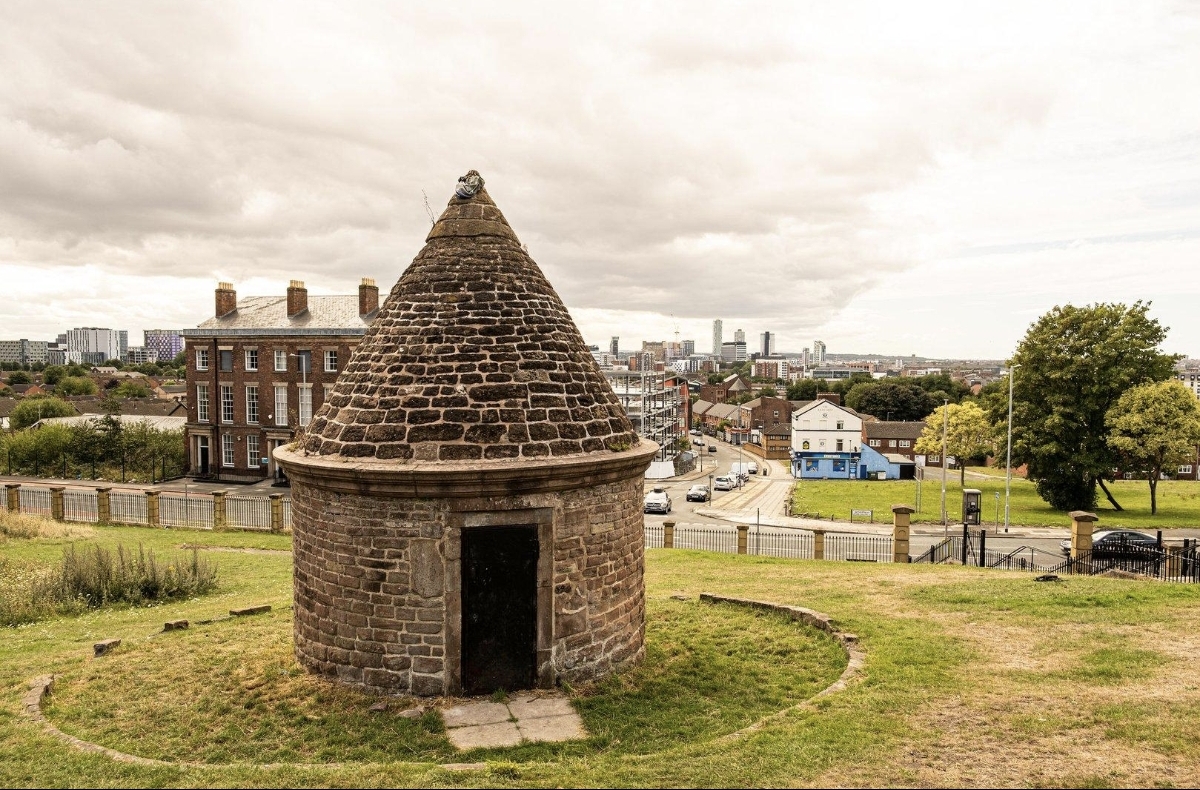
Robert Syers also recorded a wonderfully human story. When the newly fitted-out lock-up was being inspected, the local constable and his deputy went inside. A journeyman blacksmith apparently decided to test the security rather more thoroughly than intended — and locked them in. According to Syers, two of the people responsible for maintaining order in Everton therefore found themselves among the lock-up’s earliest involuntary occupants.
BROW SIDE AND THE EVERTON THAT DISAPPEARED
Another window onto the old settlement comes through the work associated with Liverpool artist William Gawin Herdman. His view of Brow Side preserves an Everton difficult to reconcile with today’s densely developed city.
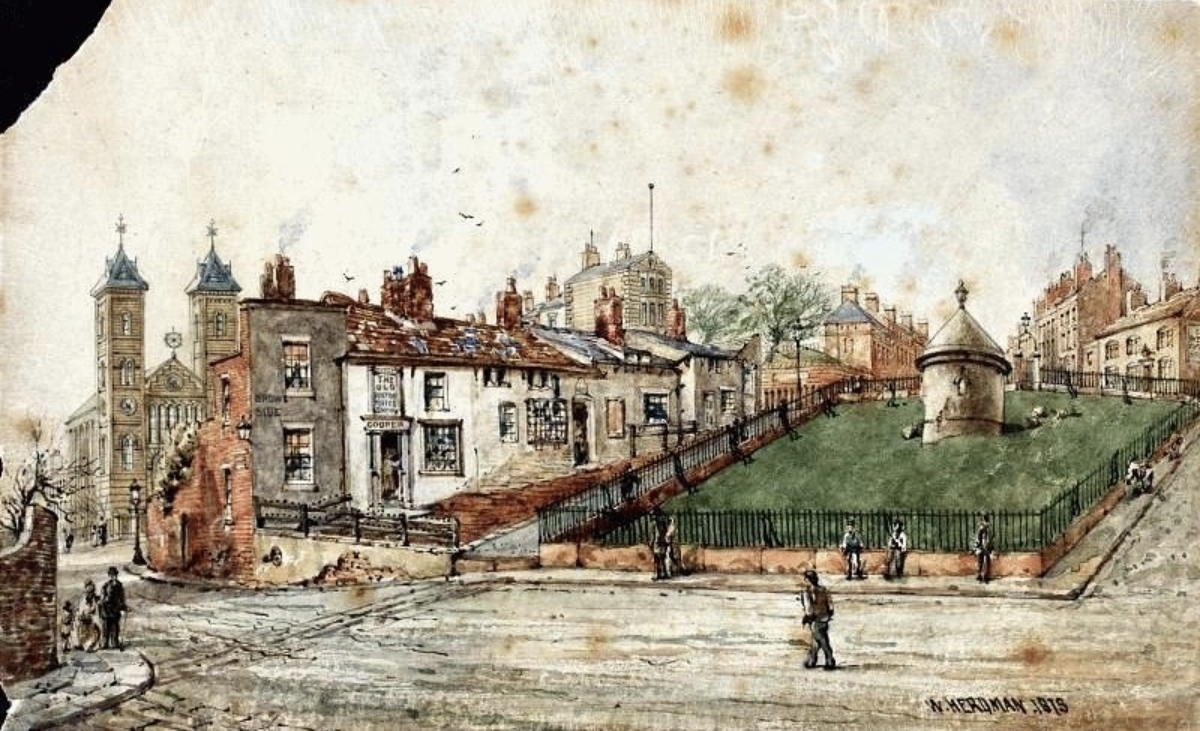
Viewed alongside the township map, it becomes obvious why geography exerted such a powerful influence over attempts to explain Everton’s name. The problem is that a convincing landscape is not the same thing as convincing etymology.
SO WHAT DOES EVERTON MEAN?
We cannot recover with absolute certainty what the people who first used the name intended. But we can distinguish between the principal explanations.
The strongest linguistic derivation is Old English eofor + tūn. The first element may refer literally to a wild boar. Alternatively, it may represent the Anglo-Saxon personal name Eofor or Efer, producing the interpretation favoured by Harrison: Eofor’s farmstead.
The competing Higher Town explanation has an authentic place in Everton’s historiography and makes striking geographical sense. But it rests on identifying Everton with Domesday’s Hiretun, an identification Harrison rejected.
The hill explains the theory. It probably does not explain the name.
FROM AN ANGLO-SAXON SETTLEMENT TO A NAME KNOWN AROUND THE WORLD
There is a fitting final chapter. The little 1787 Everton Lock-Up did not merely survive the destruction and rebuilding of the old township. In the twentieth century it was incorporated into the badge of Everton Football Club.
The club had taken its name from the district. The district had inherited its name from a settlement whose history stretched back into medieval — and probably Anglo-Saxon — England. The surviving village lock-up became a symbol carried wherever Everton’s football identity travelled.
The fields vanished. The old village was absorbed. Streets and terraces covered the surrounding landscape. Liverpool became one of the world’s great ports, and Everton became part of a vast industrial city.
But the name survived.
Somewhere within those seven familiar letters may still be the memory of an Anglo-Saxon farmstead — perhaps even the name of a man called Eofor. More than nine centuries later, Liverpool is still saying it.
Citations
SOURCES & FURTHER READING
- Henry Harrison — The Place Names of the Liverpool District (1898). Everton, the Eofor/Efer interpretation and Harrison’s rejection of the Hiretun identification.
- Robert Syers — The History of Everton (1830). The historic Hiretun/Higher Town interpretation, early Everton history and the Lock-Up anecdote.
- Liverpool Historic Settlement Study. Early form Evretona (1094), place-name derivation and development of the historic settlement.
- Historic England. Statutory listing information for the Everton Lock-Up, including its 1787 date, construction and Grade II status.
- Liverpool Record Office. Historic Everton material and the W. G. Herdman collection.
- Everton FC Heritage Society. Research into the Everton Lock-Up, the historic township and the Lock-Up as part of Everton Football Club’s identity.
Continue the conversation
Share this Liverpool story
Follow Out in Liverpool or bring your own memories and knowledge to the Community Group.